Increase in Authorized Share Capital (SH-7)
Are you looking for Increase in Authorized Share Capital (SH-7)? If your company plans to issue more shares but the existing authorized capital limit is insufficient, you must first increase the authorized share capital by passing the required Board and Shareholder resolutions and filing Form SH-7 with the ROC under the Companies Act, 2013. This legal process allows your company to raise its capital limit so you can issue additional shares without any compliance issues, penalties, or future complications. Timely filing ensures smooth fundraising, investor entry, and business expansion. Our expert compliance team manages the entire process for you — from document preparation and resolution drafting to accurate ROC filing — ensuring quick, hassle-free, and legally compliant service so you can focus on growing your business.
SH-7 Filing Help? Connect Now!
Legal Compliance Under Companies Act, 2013
Increase in Authorized Share Capital (SH-7) must be carried out strictly in accordance with the provisions of the Companies Act, 2013.
The Articles of Association (AOA) must authorize the increase; if not, it must be amended before proceeding.
A valid Board Meeting must be conducted with proper notice, quorum, and recorded minutes.
Shareholders must pass an Ordinary Resolution in a duly convened General Meeting.
The Capital Clause of the Memorandum of Association (MOA) must be formally altered after approval.
Form SH-7 must be filed with the ROC within 30 days from the date of passing the resolution.
Certified copies of resolutions and altered MOA must be attached with the ROC filing.
Applicable ROC fees and stamp duty (if any) must be paid as per prescribed rules.
The company must update its statutory registers, including the Register of Members and related records.
The revised authorized capital details should be reflected in future ROC filings and company documents.
Proper compliance ensures the company can legally issue additional shares within the new limit.
Non-compliance, incorrect filing, or delay may result in additional fees, penalties, and legal action against the company and its officers in default.
Eligibility & Requirements for Increasing Authorized Share Capital
To increase the authorized share capital of a company, certain legal requirements must be fulfilled under the Companies Act, 2013. First, check whether the Articles of Association (AOA) allows an increase in authorized capital. If not, the AOA must be amended by passing a Special Resolution before proceeding. The Capital Clause of the Memorandum of Association (MOA) will also be altered after approval, so both documents must be properly reviewed and aligned. A Board Meeting must be conducted to approve the proposal and to call a General Meeting of shareholders, where an Ordinary Resolution is required to authorize the capital increase.
The company should be active and fully compliant with MCA requirements, including updated annual filings and directors’ KYC, to avoid delays or rejection. Proper notices must be issued, resolutions should be correctly drafted, and meeting minutes must be maintained as per law. After completing all approvals, Form SH-7 must be filed with the ROC within the prescribed time along with certified copies of resolutions, altered MOA, and applicable government fees. Once approved, the company can legally issue additional shares within the revised authorized capital limit without any compliance risk.
Requirements for Increase in Authorized Share Capital
Increase in Authorized Share Capital (SH-7) is the process through which a company increases the maximum share capital it is authorized to issue to shareholders. To complete this, the company must first check whether its Articles of Association permit such an increase; if not, they must be amended by passing a special resolution. Thereafter, the Board of Directors approves the proposal and calls a general meeting to obtain shareholders’ approval through an ordinary resolution. After approval, Form SH-7 is filed with the Registrar of Companies along with the required resolutions, amended Memorandum of Association, and applicable government fees. Proper compliance with the Companies Act, 2013 and timely MCA filing are essential for successful approval.
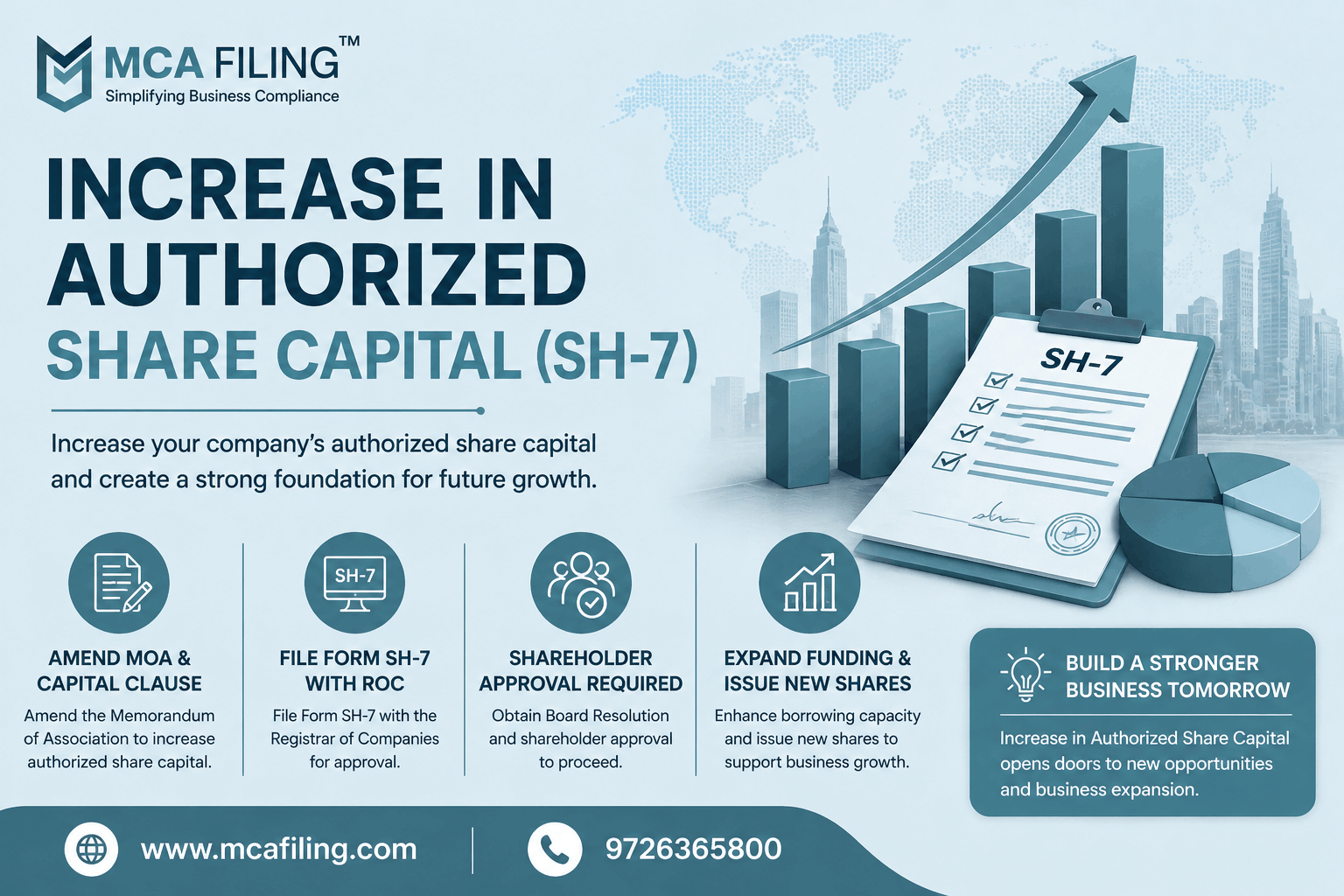
Our Simple Process to Increase Authorized Share Capital (SH-7)
We first check your company’s Articles of Association (AOA) to confirm whether capital increase is allowed. If any amendment is required, we guide you accordingly. Then we draft the necessary Board Resolution and plan the complete compliance process.
Our team conducts the Board Meeting procedure and prepares all required documents to call the General Meeting. We draft and pass the Ordinary Resolution from shareholders to legally approve the increase in authorized share capital and alter the Capital Clause of the MOA.
We prepare Form SH-7 with all required attachments, including certified copies of resolutions and altered MOA. The form is filed with the ROC within 30 days along with the prescribed government fees to ensure timely compliance.
After submission, we track the application with the ROC, respond to any queries (if raised), and ensure smooth approval. Once approved, your company can legally issue additional shares within the new authorized capital limit without any compliance risk.
Complete Document Checklist for SH-7 Filing
To successfully Increase in Authorized Share Capital (SH-7) certain documents must be prepared and attached with the ROC filing. Proper documentation ensures smooth approval and avoids rejection or resubmission. Below is the list of documents generally required for SH-7 filing:
Certified True Copy of the Ordinary Resolution passed by shareholders
Notice of General Meeting along with Explanatory Statement
Certified True Copy of Board Resolution approving the proposal
Altered Memorandum of Association (MOA) reflecting revised capital clause
Altered Articles of Association (AOA), if amended
Digital Signature Certificate (DSC) of the authorized director
Company PAN and CIN details
Any other supporting documents, if required by ROC
Preparing these documents accurately is very important for timely approval and proper legal compliance.
ROC Filing Fees & Government Charges for SH-7
SH-7 is required to be filed with ROC for increasing the authorized share capital of a company. The form must be filed within 30 days from the date of passing the Ordinary Resolution to ensure proper compliance and avoid additional penalties.
Fees:
Total Charges: ₹10,000
Board Resolution & Shareholder Approval Requirement
Before filing SH-7, your company must complete two important approval steps. First, the Board of Directors must hold a Board Meeting to discuss and approve the proposal for increasing the authorized share capital. In this meeting, the board passes a resolution approving the capital increase and decides to call a General Meeting of shareholders for final approval.
After the board’s approval, shareholders must pass an Ordinary Resolution in the General Meeting to officially approve the increase in authorized capital and the alteration of the Capital Clause of the MOA. This shareholder approval is legally mandatory under the Companies Act, 2013. Without passing the Ordinary Resolution, Form SH-7 cannot be filed with the ROC, and the capital increase will not be considered valid.
Time Limit & Penalty for Late Filing of SH-7
Form SH-7 must be filed with the ROC within 30 days from the date of passing the Ordinary Resolution.
Filing within the time limit is mandatory under the Companies Act, 2013.
If there is any delay, additional ROC fees will be charged as per MCA rules.
The longer the delay, the higher the additional fees payable.
Continuous or major delay may lead to penalties on the company and its officers in default.
Non-compliance can also create issues in future ROC filings and approvals.
Timely filing helps avoid extra costs, legal complications, and unnecessary compliance risks.
Unlock Bigger Growth: Increase Your Share Capital with Ease (SH-7 Experts)
📍 Serving Locations: All India | Based in Ahmedabad
📞 Call Us: 97263 65800 | 97263 65444
📧 Email Us: office@mcafiling.com
📄 Our Service: Increase in Authorized Share Capital (SH-7 Filing)
💼 Why Choose Us?
✔️ Experts in share capital restructuring & compliance
✔️ Smooth and fast SH-7 filing process
✔️ End-to-end documentation support
✔️ PAN India service coverage
✔️ Transparent & cost-effective pricing
FAQs – Increase in Authorized Share Capital (SH-7)
Yes, filing SH-7 with ROC is compulsory after passing shareholder resolution.
No, shares cannot be issued beyond the authorized capital limit.
Within 30 days from the date of resolution.
Company may face penalties and cannot legally increase capital.