Registration / Modification of Charge (CHG-1)
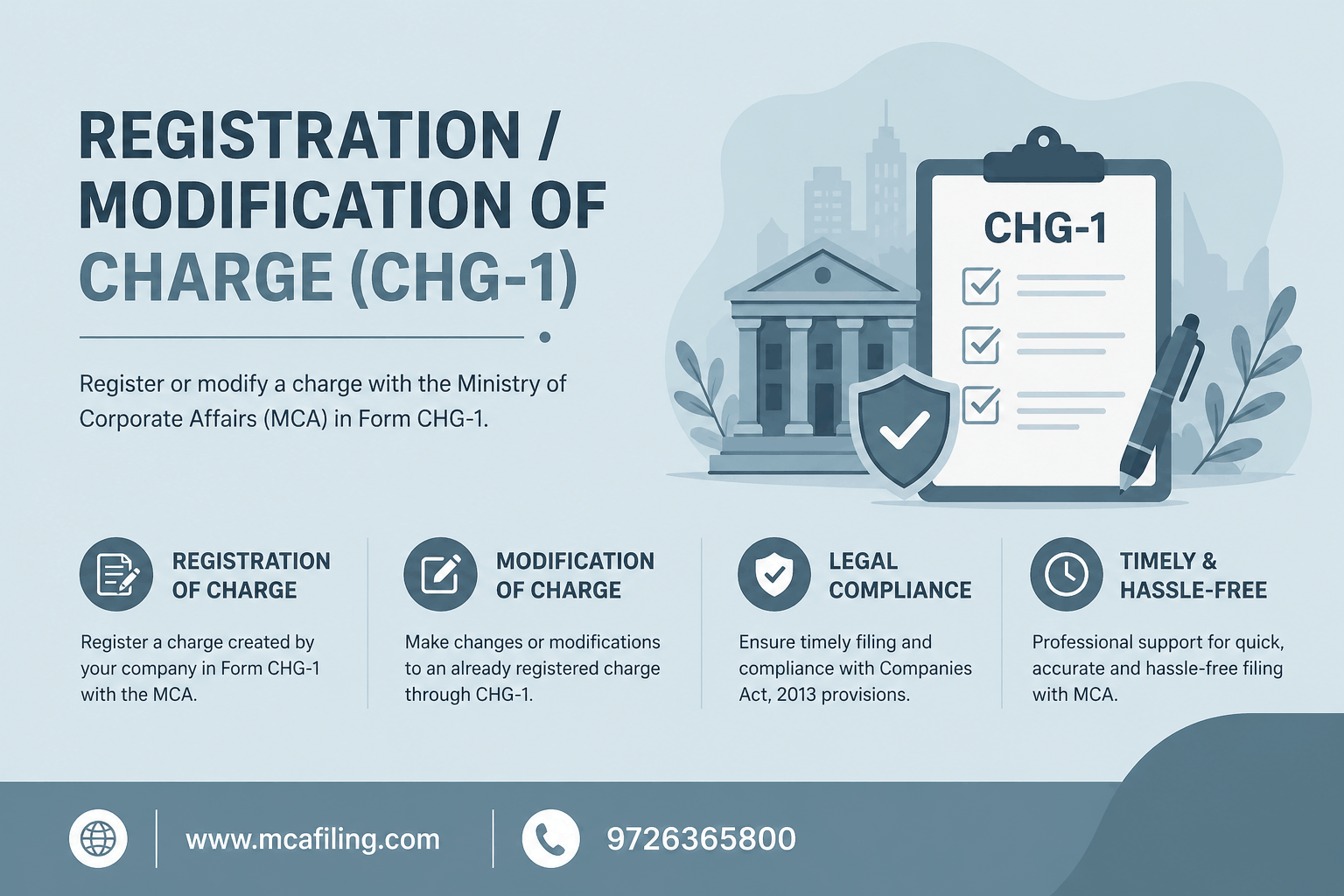
Are you looking for Registration / Modification of Charge (CHG-1)? Companies that create or modify charges on their assets, like property, machinery, or equipment, must register them under the Companies Act, 2013. Form CHG-1 is used to register a new charge or update an existing one. Timely filing ensures compliance with ROC rules and protects the rights of lenders and creditors. The process requires submitting key documents, such as board resolutions and charge details, through the MCA portal. Proper registration provides a clear record of secured assets and helps companies manage loans efficiently. Filing on time also avoids penalties and ensures smooth financial and legal operations.
Need CHG-1 for Charge Registration?
Eligibility and Requirements for Filing Form CHG-1
Any company, whether private or public, that creates a charge on its assets must file Registration / Modification of Charge (CHG-1) with the Registrar of Companies. This applies to charges on movable or immovable assets such as property, machinery, equipment, or other valuable company assets. Filing ensures the charge is legally valid, protects the rights of lenders and creditors, and provides an official record of secured assets. Timely registration helps companies avoid penalties, ensures compliance with ROC regulations, and maintains transparency in financial and legal matters.
Companies that modify an existing charge—such as changing the charge amount, updating the secured asset, or altering the terms—are also required to file CHG-1. This filing covers both secured and floating charges and is mandatory under Sections 77 to 87 of the Companies Act, 2013. Proper registration and timely modification not only prevent legal disputes but also make it easier for companies to manage loans and financing efficiently. By staying compliant, companies strengthen their credibility with lenders, maintain clear records, and ensure smooth financial and legal operations.
Key Requirements for Filing Form CHG-1
To file Form CHG-1, a company must comply with the provisions of the Companies Act, 2013 by submitting the form to the Ministry of Corporate Affairs within 30 days of creating or modifying a charge on its assets. The company should have complete and accurate details, including the date of charge, type of charge (fixed or floating), amount secured, and particulars of the lender or charge holder. It is also necessary to attach supporting documents such as the instrument of charge (loan agreement or sanction letter) and a board resolution authorizing the borrowing. The form must be digitally signed by an authorized director using a Digital Signature Certificate (DSC), and all relevant information about the charged assets must be clearly specified to ensure legal validity, transparency, and compliance with statutory requirements.
Step-by-Step Procedure for Registration or Modification of Charge
We help you prepare all required documents, including the board resolution, instrument of charge, loan agreements, and auditor certificates, so everything is ready for filing.
Our team fills out Form CHG-1 on the MCA portal with accurate details like charge type, asset description, secured amount, and lender information, using the company’s DSC.
We ensure all supporting documents are attached correctly in PDF format and verify all details before submitting the form to avoid errors or rejection.
We take care of the ROC filing fees and download the acknowledgment slip for you, giving proof of successful submission and compliance.
Documents Required for CHG-1 Charge Registration
To register or modify a charge using Registration / Modification of Charge (CHG-1), companies need to submit certain important documents. These documents ensure that the charge is legally valid, properly authorized, and compliant with ROC requirements. Having all documents ready before filing makes the process smooth and helps avoid delays or rejections.
Required Documents:
Board Resolution – Certified copy approving the creation or modification of the charge.
Instrument of Charge – Copy of the charge agreement, such as mortgage, hypothecation, or debenture agreement.
Loan or Financing Agreement – Copy of the relevant loan or financing document, if applicable.
Auditor’s Certificate – Certificate confirming the amount of secured debts (required for modifications in certain cases).
Digital Signature Certificate (DSC) – DSC of the authorized signatory for online filing with MCA.
ROC Filing Fees and Government Charges for CHG-1
The ROC filing fees for CHG-1 (Registration / Modification of Charge) depend on the type of company and the amount of charge being registered or modified, as prescribed by the Ministry of Corporate Affairs (MCA).
Fee Structure Overview:
- Small Company – Fees may start from ₹200–₹500 (depending on charge amount).
- Private Limited Company – Fees vary based on the secured amount, usually from ₹500 to several thousand rupees.
- Public Limited Company – Higher fees as per MCA schedule.
Professional Charges:
- Our Service Charges: ₹3,000
Important Note:
Delayed filing attracts additional fees and penalties. Timely submission of CHG-1 ensures compliance, avoids extra charges, and keeps your company legally protected.
Statutory Time Limit for Filing Form CHG-1
Filing Deadline: CHG-1 must be filed within 30 days from the date of creation or modification of the charge.
Late Filing Consequences: Delay attracts additional fees and penalties and may lead to legal complications.
Protects Stakeholders: Timely filing safeguards the interests of both the company and lenders.
Avoids Rejection: Filing on time reduces the chances of the form being rejected by the ROC.
Maintains Transparency: Proper filing ensures a clear record of secured assets, helping future audits and financing.
Supports Legal Compliance: Helps the company stay fully compliant with Sections 77 to 87 of the Companies Act, 2013.
Smooth Financial Operations: On-time filing ensures hassle-free loan management and financial dealings with banks or creditors.
Common Errors to Avoid While Filing CHG-1
- Entering incorrect charge amount or lender details can lead to rejection.
- Missing or incomplete instrument of charge may delay approval.
- Filing without a certified board resolution is a common mistake.
- Using the wrong Digital Signature Certificate (DSC) or uploading documents in the wrong format can cause filing issues.
- Delaying submission beyond the statutory 30-day period attracts extra fees and penalties.
- Providing vague or incorrect asset details may result in form rejection.
- Ensure all details match the loan agreements, charge documents, and auditor certificates to avoid errors.
Secure Your Company Loans Properly (CHG-1 Filing Made Easy)
📍 Serving Locations: All India | Based in Ahmedabad
📞 Call Us: 97263 65800 | 97263 65444
📧 Email Us: office@mcafiling.com
📄 Our Service: Registration / Modification of Charge (CHG-1)
💼 Why Choose Us?
✔️ Simple and hassle-free filing process
✔️ Expert support for loan-related compliance
✔️ PAN India service coverage
✔️ Timely filing to avoid penalties
FAQs – CHG-1 Filing
CHG-1 is a form used to register or modify a charge created by a company on its assets under the Companies Act, 2013.
Any company creating a new charge or modifying an existing charge on its assets must file CHG-1 with ROC.
Yes, any change in charge amount, lender, or asset requires filing CHG-1 for modification.
Yes, ROC accepts CHG-1 only if approved by Board and signed by an authorized person.