Secretarial Audit Service
Are you looking for Secretarial Audit Service? Our professional Secretarial Audit helps your company stay fully compliant with all corporate laws, rules, and regulations, avoiding penalties and legal issues. We carefully review your company’s records, minutes, filings, and statutory documents to ensure everything is accurate, up-to-date, and in line with the Companies Act. By identifying gaps and providing practical solutions, we help improve corporate governance, maintain transparency, and build trust with stakeholders, investors, and regulators. With our expert guidance, you can focus on growing your business while we take care of all compliance requirements efficiently and reliably. For more information or personalized assistance, connect with us today.
Get Reliable Secretarial Audit Today !
Overview of Secretarial Audit
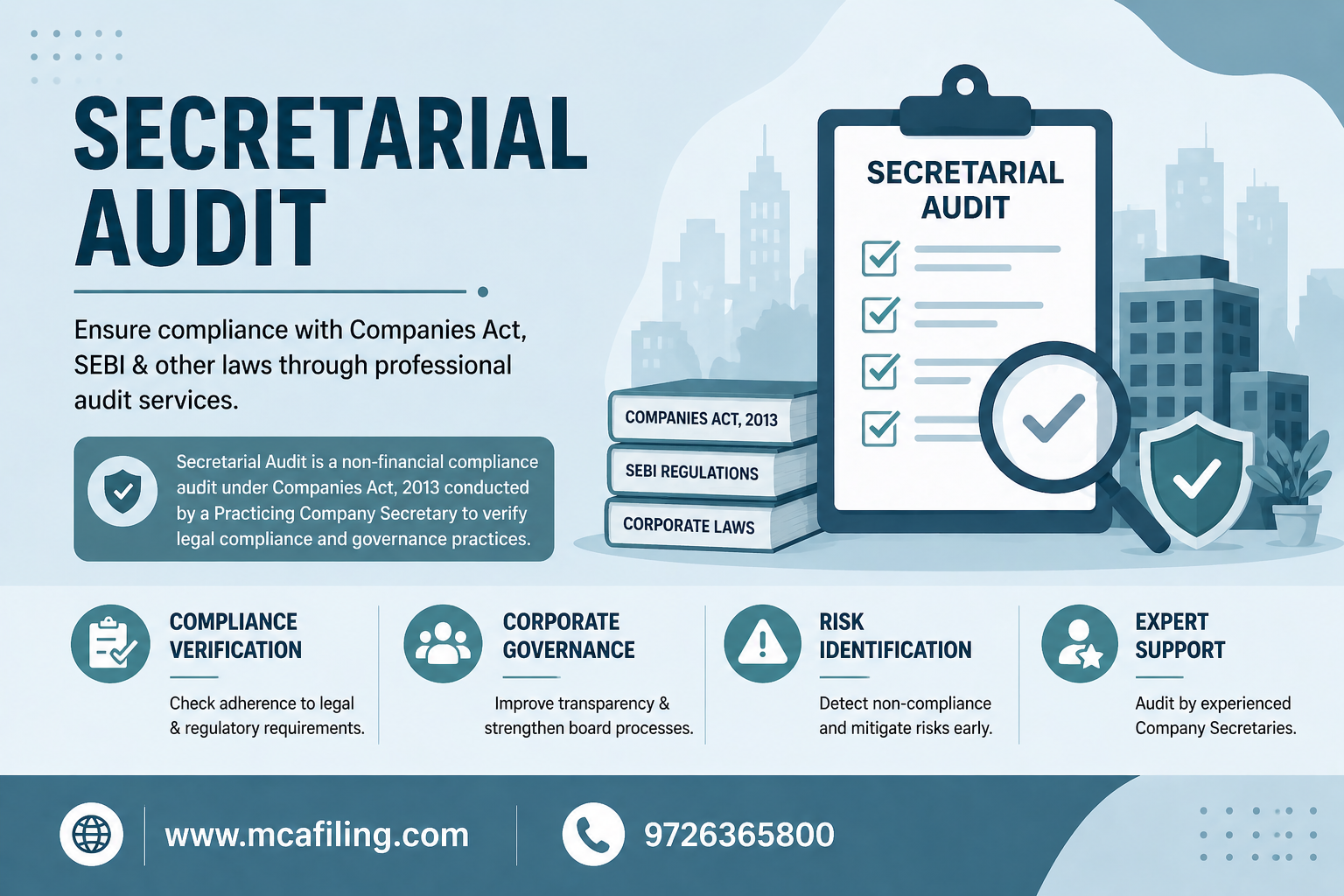
A Secretarial Audit is a comprehensive review of your company’s compliance with all applicable corporate laws, rules, and regulations. It ensures that your business strictly follows the Companies Act, SEBI guidelines, and other legal requirements. By conducting a Secretarial Audit Service companies can identify compliance gaps, avoid fines or penalties, and strengthen their internal governance practices. It is a proactive way to maintain transparency, improve operational efficiency, and build confidence among stakeholders, investors, and regulators.
During the audit, our team of experts thoroughly examines your company’s statutory records, board resolutions, filings, contracts, and other important documents. We check whether your processes are aligned with legal requirements and provide actionable recommendations to address any discrepancies. Apart from keeping your business legally safe, a Secretarial Audit also helps enhance corporate credibility, ensures smooth regulatory approvals, and supports better decision-making at the management level. By investing in a Secretarial Audit, you not only protect your company but also showcase professionalism and accountability to everyone associated with your business.
Applicability of Secretarial Audit
The Secretarial Audit applies to specific categories of companies as defined under the Companies Act, 2013. It ensures that these companies are following all legal and regulatory requirements in their operations. While it is mandatory for some, it is highly recommended for others to maintain transparency and corporate discipline.
Here’s who needs a Secretarial Audit Service:
- Listed Companies: Mandatory for all companies listed on any recognized stock exchange.
- Public Limited Companies: Required if the paid-up share capital is ₹50 crore or more or annual turnover is ₹250 crore or more.
- Private Limited Companies: Applicable if they meet the prescribed financial limits or are subsidiaries of public companies.
- Subsidiaries of Public Companies: Must conduct audits if the parent or subsidiary falls under mandatory limits.
- NGOs and Section 8 Companies: Recommended for ensuring proper legal and statutory compliance.
- Startups and Emerging Businesses: Helpful for building investor confidence and keeping records compliant.
Why Your Company Needs a Secretarial Audit?
A Secretarial Audit is important for every company because it helps make sure your business follows all the rules and regulations. It checks your company’s records, filings, and processes to find any mistakes or gaps before they turn into legal problems. Whether you are a private limited company, a listed company, or a startup, a Secretarial Audit keeps your operations smooth, lawful, and well-organized.
Regular audits also help your company build trust with investors, stakeholders, and regulators. It shows that your business is professional, transparent, and serious about following the law. A Secretarial Audit doesn’t just keep you safe—it also makes your company stronger and more credible in the eyes of everyone involved.
Why a Secretarial Audit is Beneficial:
✅ Finds and fixes compliance gaps before they become issues
✅ Reduces the risk of fines or penalties
✅ Improves governance and internal processes
✅ Builds trust with investors, stakeholders, and regulators
✅ Keeps your company organized and transparent
Legal Framework Governing Secretarial Audit
A Secretarial Audit is carried out under the legal framework of the Companies Act, 2013, particularly Sections 204 and 205, along with the SEBI (Listing Obligations and Disclosure Requirements) Regulations for listed companies. These laws ensure that every company follows proper procedures, maintains accurate records, and meets all legal and regulatory requirements. The main objective of this framework is to promote transparency, accountability, and good corporate governance in every organization.
Under these provisions, certain classes of companies—such as listed companies, public companies above a certain threshold, and other prescribed entities—must get their Secretarial Audit done by a qualified Company Secretary in practice. The audit covers a wide range of laws, including the Companies Act, SEBI rules, FEMA regulations, the Depositories Act, and various other industry-specific laws. It ensures that directors, key managerial personnel, and compliance officers are fulfilling their legal responsibilities.
Documents Required for Secretarial Audit
To carry out a Secretarial Audit smoothly, the company needs to provide certain key documents and records. These help the auditor check if all legal requirements and company laws are properly followed. Keeping these documents well-organized not only makes the audit faster but also helps identify and correct compliance gaps easily.
List of Important Documents for Secretarial Audit:
- Memorandum and Articles of Association (MOA & AOA): Define the company’s objectives, internal rules, and structure.
- Board Meeting Minutes and Resolutions: Records of board decisions and approvals made during meetings.
- Registers of Members, Directors & Key Managerial Personnel: Details of shareholders, directors, and senior officers.
- Statutory Filings with the Ministry of Corporate Affairs (MCA): Copies of annual returns, financial statements, and other mandatory filings.
- Agreements and Contracts: Any business contracts, vendor agreements, or legal documents relevant to company operations.
- Share Certificates and Transfer Registers: Records related to issue and transfer of company shares.
Compliance Reports and Correspondence: Copies of compliance certificates, audit reports, and communications with regulatory authorities.
How Much Does a Secretarial Audit Cost?
The professional fees for conducting the Secretarial Audit in accordance with the provisions of the Companies Act, 2013 and guidelines issued by the Institute of Company Secretaries of India is ₹20,900 (inclusive of GST), which is determined based on the scope of work, level of compliance review required, and professional responsibility involved in certification.
How to Incorporate a Private Limited Company: A Complete Process
We start by collecting and reviewing key company documents like MOA, AOA, board minutes, registers, and statutory filings to understand your compliance status.
we check all your filings, records, and approvals to ensure they follow the Companies Act, SEBI guidelines, and other applicable laws.
Any missing filings, delays, or irregularities are noted, and we provide clear guidance on how to correct them effectively.
Finally, we prepare a detailed Secretarial Audit Report that highlights observations, compliance status, and practical recommendations for future improvements.
Why Secretarial Audit is Important for Your Company ?
Secretarial Audit isn’t just about following the law — it’s about keeping your company safe, transparent, and well-managed. It helps you stay on the right side of corporate rules while improving your organization’s efficiency and credibility. Whether you run a private limited company, a listed entity, or a growing startup, a Secretarial Audit adds real value by building trust and reducing risks.
Key Benefits of Secretarial Audit:
- Ensures full legal compliance: Keeps your company updated with all corporate and regulatory laws.
- Avoids penalties and fines: Identifies compliance issues early and helps fix them before they become costly problems.
- Improves corporate governance: Encourages accountability and better decision-making at all management levels.
- Enhances transparency: Builds a culture of openness and reliability within the organization.
- Boosts investor and stakeholder confidence: Shows that your company operates responsibly and ethically.
- Prevents legal disputes: Reduces the chances of legal conflicts through timely and proper compliance checks.
- Saves time and resources: Makes your compliance management more efficient and organized.
- Protects company reputation: Keeps your brand image strong by maintaining a clean legal record.
- Helps in business growth: Creates a stable foundation for expansion, funding, and partnerships.
- Improves internal control systems: Ensures all departments follow standard procedures and maintain accurate records.
Key Compliance Areas Covered in Secretarial Audit
- Verification of company governance, board meetings, and decision-making procedures.
- Checking timely filing of annual returns, financial statements, and other forms with the MCA.
- Ensuring all statutory registers and company records are properly maintained and updated.
- Reviewing labor law compliance, employee welfare policies, and related filings.
- Examining SEBI and stock exchange regulations for listed companies.
- Checking compliance with FEMA and foreign exchange laws for international transactions.
- Reviewing environmental, safety, and industry-specific regulations applicable to the business.
- Verifying intellectual property protection, contracts, and legal documentation.
- Ensuring transparency in disclosures, corporate reporting, and communication with stakeholders.
- Identifying non-compliance areas and providing corrective recommendations for improvement.
Types of Secretarial Audits
Different companies need different kinds of Secretarial Audits based on their size, nature of business, and legal requirements. Each type helps ensure that the company is following the right laws and maintaining proper records. Here are the main types explained simply:
1. Statutory Secretarial Audit:
This is the mandatory audit required under the Companies Act, 2013 for listed and large public or private limited companies. It checks whether all legal and regulatory rules are being followed correctly.
2. Internal or Voluntary Secretarial Audit:
Some companies choose to do this audit even when it’s not compulsory. It helps them find and fix compliance issues early, stay organized, and be fully ready for any government or external inspection.
3. Sector-Specific Secretarial Audit:
Businesses in sectors like banking, insurance, NBFCs, and listed companies often need special audits. These are done to meet specific rules set by regulators such as SEBI, RBI, or IRDAI
Contact Us for Professional Secretarial Audit Services
Looking for expert help with your company’s Secretarial Audit? Our team of qualified professionals is here to guide you through every step — from reviewing your company’s records to preparing a complete compliance report. We make the entire process simple, transparent, and hassle-free for your business.
Whether you’re a private limited company, public company, or startup, we offer customized Secretarial Audit services to match your needs. Call us today at +91 9726365800 or visit www.mcafiling.com to schedule your audit and ensure your company stays fully compliant.
Frequently Asked Questions About Private Limited Company Incorporation
A Private Limited Company is a business entity owned by shareholders and limited by shares. It offers limited liability to its owners and operates as a separate legal entity from its shareholders.
The cost of registering a Private Limited Company can vary based on the service provider, government fees, and other additional services. Our all-inclusive registration package is ₹10,000 with no hidden charges.
Directors are responsible for managing the company’s day-to-day operations and ensuring compliance with legal and financial regulations. They act as the company’s representatives.
Yes, a Private Limited Company can be converted into other business forms, such as a Public Limited Company or a Limited Liability Partnership (LLP), subject to certain legal formalities.