Annual Return Filing by Company (MGT-7)
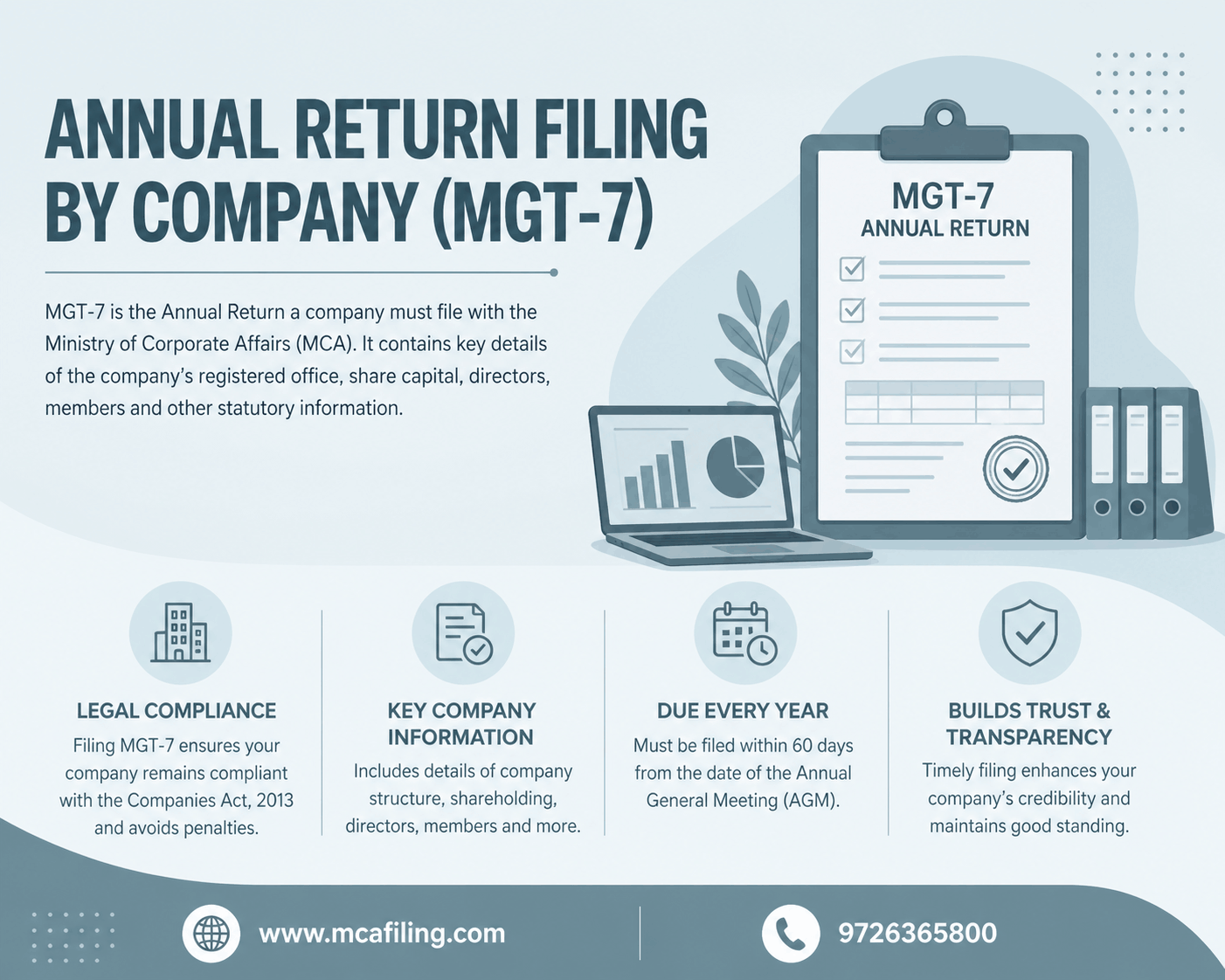
Are you searching for Annual Return Filing by Company (MGT-7)? Annual Return (MGT-7) is a compulsory yearly compliance that every company registered under the Companies Act, 2013 must file with the Registrar of Companies (ROC). This form contains complete details of the company such as shareholding pattern, directors and KMP details, registered office address, and other important corporate information as on the end of the financial year. It helps the government maintain updated records of your company’s structure and ownership. Filing MGT-7 on time is very important to avoid heavy late fees, penalties, and compliance issues. Even if your company has not carried out much business during the year, filing the Annual Return is still mandatory. Timely filing keeps your company legally compliant, maintains its active status, and builds trust with banks, investors, and other stakeholders.
Need Assistance with MGT-7 Annual Return Filing?
What is MGT-7 and Why Filing is Mandatory ?
MGT-7 is the Annual Return form that every company registered under the Companies Act, 2013 must file with the Registrar of Companies (ROC) after the completion of each financial year. This form includes complete details of the company such as its registered office address, principal business activities, share capital, shareholding pattern, directors and KMP details, shareholders, debenture holders, and other important statutory information as on the financial year end. In simple words, MGT-7 provides a yearly snapshot of the company’s structure, ownership, and management details.
Annual Return Filing by Company (MGT-7) is compulsory for all Private Limited and Public Limited Companies (except certain dormant companies as allowed under law), even if there is no major business activity during the year. It ensures transparency, keeps company records updated with government authorities, and proves that the company is legally compliant. Timely filing helps avoid heavy additional fees, penalties, and the risk of the company being marked as non-compliant. It also builds credibility with banks, investors, and other stakeholders by showing that the company regularly follows statutory compliance requirements.
Legal Compliance Under Companies Act, 2013
Filing MGT-7 is a compulsory annual compliance requirement for all applicable companies registered under the Companies Act, 2013.
It ensures that correct and updated company details such as shareholding, directors, registered office, and capital structure are officially recorded with the Registrar of Companies (ROC).
It provides a yearly snapshot of the company’s ownership and management structure as on the end of the financial year.
Proper filing promotes transparency and reflects strong corporate governance practices.
It helps maintain consistency between company records and MCA portal data, reducing the risk of discrepancies.
Accurate filing supports smooth processing of other ROC forms such as AOC-4, DIR-12, and SH-7.
It is important for statutory audit, due diligence, bank loan processing, and investor verification.
Regular compliance improves the company’s credibility and professional image in the market.
Non-compliance may result in heavy additional fees, penalties on the company and its officers, and notices from ROC.
Continuous default can create difficulties in future filings, director KYC, company strike-off matters, or other legal procedures.
Timely filing protects directors from personal liability and helps keep the company’s status active and compliant.
Companies Required to File MGT-7
Every company registered under the Companies Act, 2013 has to file its Annual Return Filing by Company (MGT-7) (or MGT-7A, if applicable) with the Registrar of Companies (ROC) once every financial year. It does not matter whether your company has done full business, limited transactions, or even no business at all — filing is still compulsory. The Annual Return keeps your company’s important details like shareholders, directors, and capital structure updated in government records. If you miss the due date, the company may have to pay heavy late fees and penalties, and it can also affect your compliance status. So, filing MGT-7 on time is very important to keep your company safe and legally active.
Companies Required to File MGT-7:
Private Limited Companies
Public Limited Companies
One Person Companies (OPC)
Small Companies
Section 8 Companies (Non-Profit Companies)
Nidhi Companies
Producer Companies
Process We Follow for Your MGT-7 Annual Return Filing
We gather all required information such as shareholding pattern, director details, and annual return data as per the Companies Act and verify the details on the MCA portal.
Our experts prepare Form MGT-7, draft the Board Resolution for approval of the Annual Return, and arrange all required attachments in the correct format.
We upload Form MGT-7 on the MCA portal and complete the digital signing using the DSC of the authorized director or signatory.
After final checking, we submit the form, pay the applicable ROC fees, and share the acknowledgment receipt for your records, ensuring your compliance is fully completed.
Complete Documents Checklist for MGT-7 Annual Return Filing
Before filing MGT-7, it is important to keep all required documents and details ready to avoid mistakes or rejection by ROC. Proper documentation helps in smooth and accurate filing of the Annual Return. Below is the list of commonly required documents and information for MGT-7 filing:
Documents & Details Required:
Certified copy of Board Resolution approving the Annual Return
List of shareholders as on the end of the financial year
List of directors and Key Managerial Personnel (KMP)
Details of share capital and shareholding pattern
Details of any changes in directors during the year
Details of transfer or change in shareholding, if any
Information about registered office and principal business activities
Financial statements for reference (as filed in AOC-4)
Digital Signature Certificate (DSC) of authorized director
Form MGT-7 duly filled and digitally signed by authorized personnel
MGT-7 Filing Fees, Due Date & Late Penalty Details
💼 Professional Fees: ₹5,000
Filing of MGT-7 (Annual Return) is a mandatory compliance requirement under the Ministry of Corporate Affairs. Proper and timely filing ensures that your company remains compliant and avoids unnecessary penalties.
📋 Key Information
| Particulars | Details |
|---|---|
| Normal ROC Fees | Government fees depend on the type of company and its authorized share capital. Higher capital attracts higher fees. |
| Due Date | Must be filed within 60 days from the date of AGM. If AGM is not held, filing is required within 60 days from the due date of AGM. |
| Late Filing Fees | Additional fees are charged on a per-day basis after the due date, increasing the total cost. |
| Penalty | Non-compliance may lead to penalties on the company and its directors/officers under the Companies Act, 2013. |
| Compliance Risk | Continuous non-filing can affect the company’s legal status and lead to further legal action. |
Common Errors to Avoid While Filing MGT-7
Entering incorrect CIN, company name, or registered office address, which can lead to rejection of the form.
Providing incomplete or wrong details of directors, shareholders, or shareholding pattern as on the financial year end.
Not updating changes in directors or share transfers before filing MGT-7.
Filing the form without using the valid Digital Signature Certificate (DSC) of the authorized director or signatory.
Delay in filing beyond 60 days from the date of AGM, resulting in heavy additional fees.
Attaching incorrect, unclear, or incomplete supporting documents.
Mismatch between details filed in MGT-7 and financial statements filed in AOC-4.
Selecting wrong company category or capital structure details in the form.
Not verifying pre-filled data from the MCA portal before final submission.
Submitting the form without proper internal checking or professional review, increasing chances of resubmission or penalties.
Annual Return Filing Made Simple (MGT-7 Experts)
📍 Serving Locations: All India | Based in Ahmedabad
📞 Call Us: 97263 65800 | 97263 65444
📧 Email Us: office@mcafiling.com
📄 Our Service: Annual Return Filing by Company (MGT-7)
💼 Why Choose Us?
✔️ Easy and smooth filing process
✔️ Expert support for all compliance needs
✔️ PAN India service coverage
✔️ On-time filing to avoid penalties
✔️ Affordable and transparent pricing
FAQs on Annual Return (MGT-7) Filing
MGT-7 must be filed within 60 days from the date of AGM.
Small companies and one-person companies (OPC) are generally exempt unless specified.
Late fees depend on authorized capital; continuing delay may lead to fines for directors.
Yes, but only under specific rectification provisions; it must be filed correctly to avoid penalties.