Commencement of Business Intimation (INC-20A)
Are you planning to start business operations for your newly incorporated company? Filing the Commencement of Business Intimation (INC-20A) is a mandatory requirement under the Companies Act, 2013. This form serves as a declaration that the company has received the minimum paid-up capital and has a registered office, allowing it to legally commence business. In this guide, we simplify the entire process for you — covering step-by-step filing instructions, required documents, applicable fees, deadlines, and common compliance issues. By following these guidelines, you can ensure timely filing and avoid penalties, giving your company a smooth start in its business journey.
File INC-20A – Start Your Business Now
Overview of INC-20A
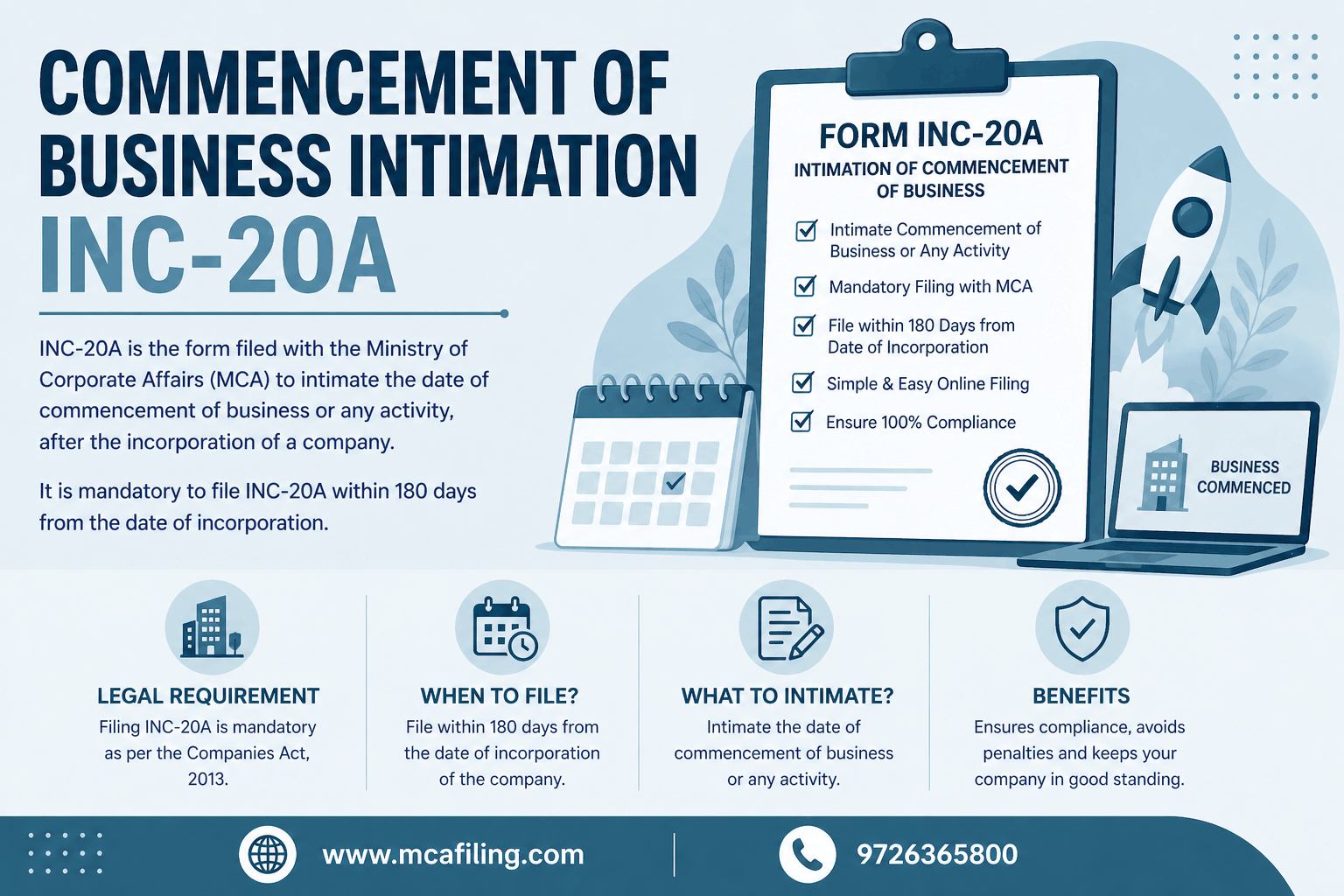
Form INC-20A, also known as the Commencement of Business Declaration, is a mandatory filing required for all companies registered in India after 2nd November 2018. It must be filed with the Ministry of Corporate Affairs (MCA) within 180 days from the date of incorporation. This form confirms that the company has received its paid-up share capital from shareholders and has verified its registered office address. Simply put, it’s a way of informing the government that your company is ready to begin business activities.
Commencement of Business Intimation (INC-20A) is not just a formality — it’s an important compliance step that gives your company the legal approval to start operations, open a current bank account, and raise funds. If you skip or delay this filing, your company may face penalties, restrictions on business transactions, or even the risk of being struck off the MCA register. By filing on time, you ensure that your company remains active, compliant, and trusted by banks, clients, and investors. This simple step helps your business begin its journey smoothly and without legal hurdles.
Key Rules for Filing Form INC-20A
Before starting any business activity, every newly incorporated company must file Form INC-20A with the Ministry of Corporate Affairs (MCA) to declare that it is ready to commence business. This declaration must be approved by the Board of Directors through a formal resolution. The company should have a current bank account opened in its name, and all shareholders must deposit their paid-up share capital into that account before filing.
The form must be filed within 180 days of incorporation and should be digitally signed by one of the company’s directors using a valid Digital Signature Certificate (DSC). It also needs to be certified by a practicing CA, CS, or CMA to confirm that all details are correct and compliant. All company details — such as CIN, registered address, and director information — must match the Certificate of Incorporation, and all supporting documents should follow the MCA’s prescribed format.
If the company fails to file Commencement of Business Intimation (INC-20A) on time, it may face penalties, additional fees, and the company’s status could be marked as inactive on the MCA portal. Filing the form correctly ensures that your business stays compliant and can legally begin its operations without any delay.
Applicability of Form INC-20A
Form INC-20A applies to all new companies registered under the Companies Act, 2013, and must be filed before starting any business activities. It confirms that the company has received its share capital and is ready to operate legally. Filing this form ensures that your company is recognized as active and compliant with MCA regulations.
Applicable to all companies incorporated under the Companies Act, 2013 after 2nd November 2018.
Mandatory for Private Limited, Public Limited, One Person, and Section 8 Companies.
Must be filed within 180 days from the date of incorporation.
Declares that the company has received the paid-up share capital as stated during incorporation.
Required before starting any business operations or borrowing funds.
Helps verify that the company’s registered office address is valid and active.
Ensures the company is legally recognized as active and compliant by the MCA.
Non-filing may result in penalties, restrictions, or the company being marked inactive.
Dormant companies and those incorporated before November 2018 are exempt from filing.
Timely filing builds trust with banks, clients, and investors and prevents future compliance issues.
Eligibility to File Form INC-20A
- Who Needs to File: Every company registered under the Companies Act, 2013 after 2nd November 2018 must file Form INC-20A before starting business.
Applicable Companies: It applies to Private Limited Companies, Public Limited Companies, One Person Companies (OPC), and Section 8 (Non-Profit) Companies.
Startups Covered: Newly incorporated startups that have received their Certificate of Incorporation must also file this form.
Filing Timeline: The form should be submitted within 180 days (6 months) from the date of incorporation.
Share Capital Requirement: The company must have received the paid-up share capital from all its shareholders before filing.
Bank Account Proof: A valid current bank account in the company’s name is required to show proof of capital deposit.
Digital Signature Requirement: The form must be signed by a company director using a valid Digital Signature Certificate (DSC).
Professional Certification: The form should be verified and certified by a practicing Chartered Accountant (CA), Company Secretary (CS), or Cost Accountant (CMA).
Exempted Companies: Companies incorporated before 2nd November 2018 and dormant or inactive companies are not required to file.
Purpose of Filing: Filing confirms that the company is active, compliant, and eligible to start business operations legally.
Penalty for Non-Filing: Failure to file on time may result in penalties, restrictions on operations, or even removal from MCA records.
Key Benefits of Filing: Helps the company open a bank account, raise funds, and begin business activities without legal hurdles.
Documents Required for Filing Form INC-20A
Before you file Form INC-20A, make sure you have all the necessary documents ready. These documents help the Ministry of Corporate Affairs (MCA) verify that your company is set up correctly and ready to begin business. Here’s a simple list of what you’ll need:
- Certificate of Incorporation: This confirms that your company is officially registered under the Companies Act, 2013.
- Board Resolution: A signed approval from the company’s directors allowing the start of business activities.
- Bank Statement or Proof of Capital Deposit: A copy of your company’s bank statement showing that the shareholders have deposited their share capital.
- Registered Office Proof: Documents like an electricity bill, rent agreement, or ownership paper showing your company’s official address.
- PAN and TAN of the Company: Tax identification documents issued by the Income Tax Department.
- Digital Signature Certificate (DSC): The director’s DSC is needed to sign and submit the form online.
- Professional Certification: The form must be verified by a Chartered Accountant (CA), Company Secretary (CS), or Cost Accountant (CMA).
- Additional Documents (if any): If required, you may also attach NOCs, approval letters, or other supporting papers as per MCA instructions.
Filing Fees and Charges for INC-20A
INC-20A is a mandatory compliance for every newly incorporated company to declare the commencement of business. It must be filed within 180 days from the date of incorporation to ensure the company remains compliant and avoids additional penalties.
Fees:
- Professional Fees: ₹1,000
- Government Fees: ₹300
How to File Form INC-20A for Commencement of Business ?
You just need to share a few basic details and documents like your Certificate of Incorporation, Board Resolution, and Bank Statement. You can send them to us by email or WhatsApp — whatever is easiest for you.
Our team checks your details, fills out the INC-20A form, and makes sure everything is correct as per MCA rules. We take care of all the technical and legal parts so you don’t have to worry.
Once everything is ready, we file the form online on the MCA portal, attach the professional certification, and complete the payment on your behalf.
After submission, we send you the MCA acknowledgment and SRN number as proof that your Form INC-20A is successfully filed and approved.
File Form INC-20A on Time – Avoid Penalties and Stay Compliant
Every newly incorporated company must file Form INC-20A within 180 days from the date of receiving the Certificate of Incorporation to officially start business operations. This filing confirms that all company details are correct and that the directors have deposited the subscribed share capital in the company’s bank account.
Missing the 180-day deadline can lead to notices or penalties from the Ministry of Corporate Affairs (MCA), and your company may be marked as inactive. Delayed filing can also affect your company’s credibility and delay business operations.
Common Mistakes to Avoid While Filing Form INC-20A
Make sure the company name and CIN are exactly the same as on the Certificate of Incorporation.
Upload all required documents like the Board Resolution, Certificate of Incorporation, Bank Statement, and proof of your registered office.
File the form within 180 days of incorporation to avoid fines or MCA notices.
Check that the paid-up share capital in the form matches what shareholders have deposited in the company bank account.
Use the Digital Signature Certificate (DSC) of a director to sign the form properly.
Double-check all director details, including DIN and personal info, to make sure they match MCA records.
Have the form verified by a CA, CS, or CMA before submitting.
Follow the MCA’s document format rules to prevent delays or rejection.
Trusted INC-20A Filing Consultant Near You
📍 Serving Locations: All India | Based in Ahmedabad
📞 Call Us: 97263 65800 | 97263 65804
📧 Email Us: office@mcafiling.com
📄 Our Service: Commencement of Business Intimation (INC-20A Filing)
💼 Why Choose Us?
✔️ Expert guidance on INC-20A compliance
✔️ Quick & hassle-free filing process
✔️ PAN India service support
✔️ Accurate documentation & verification
✔️ Affordable and transparent pricing
FAQs – Commencement of Business Intimation (INC-20A)
INC-20A is a mandatory declaration filed by a Private Limited Company after incorporation to confirm that the company has received its subscription money and is ready to commence business activities as per MCA rules.
Every Private Limited Company incorporated in India having share capital is required to file INC-20A within the prescribed time after incorporation. Without this filing, the company cannot legally start business operations.
INC-20A must be filed within 180 days from the date of incorporation of the company. Delay in filing may lead to penalties and restrictions on business commencement.
If INC-20A is not filed within the due date, the company may face penalties and compliance issues, and MCA can restrict the company from commencing business activities until the filing is completed.